
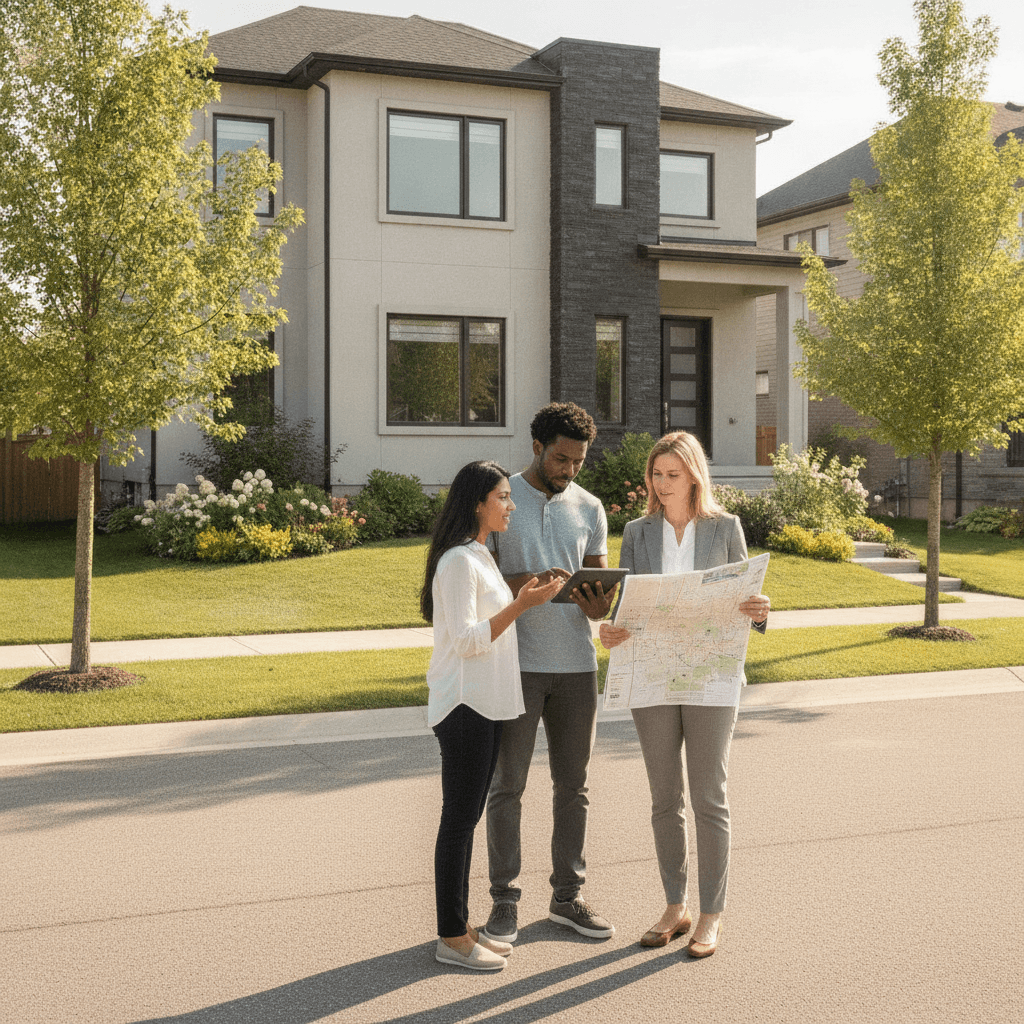
Brampton home buying guide refers to a step-by-step plan to search listings, tour homes, make offers, and close in Brampton. From our office at 470 Chrysler Dr #20, we use a location-based property search and a What’s My Home Worth tool to simplify choices. This guide shows exactly how to move from planning to keys-in-hand.
By Maunil (Maunil Bhupendra) Shah — Sales Representative, HomeLife/Miracle Realty Ltd., Brokerage
Last updated: 2026-06-14
Summary
Use this Brampton home buying guide to align financing, neighborhood search, tours, offer strategy, conditions, and closing. Start with pre-approval, define needs vs. wants, tour intentionally, protect yourself with the right conditions, and track documents to close smoothly. Local tips and real mini-cases are included.
- Pre-approval clarifies your ceiling and strengthens offers.
- Neighborhood-first search saves time; map schools, transit, and commute.
- Tour with a purpose: verify layout, light, noise, and repair red flags.
- Offers win with clean terms, realistic timelines, and proof of readiness.
- Conditions (financing, inspection, status certificate) mitigate risk.
- Closing is project management: track dates, funds, and keys.
Above-Fold: Your 2026 Brampton home buying game plan
Your fastest route to a home in Brampton is simple: confirm financing, search by location, tour with a checklist, make a defensible offer, and manage conditions through to closing. We streamline this from our Brampton office using curated listings, valuation insights, and hands-on guidance.
Here’s the thing: speed without structure leads to rework and regret. We combine a neighborhood-first search with precise offer playbooks so you’re prepared before you even step inside the first showing.
- Kickoff call (20 minutes): Clarify goals, timelines, and any non-negotiables (parking, schools, commute).
- Pre-approval alignment: Share a letter that verifies borrowing power and conditions. Many lenders target debt service ratios below common thresholds.
- Smart search setup: We create saved searches by radius, school catchment, and transit corridors.
- Offer strategy briefing: Review comparables, condition types, and realistic timelines for seller acceptance.
- Closing roadmap: Appraisal, legal review, insurance, final walk-through, and keys—sequenced with reminders.
Quick reality check: Most successful buyers keep a shortlist to five homes and write one strong, data-backed offer. We’ll help you do the same—calmly and confidently.
What is a Brampton home buying guide?
A Brampton home buying guide is a local, step-by-step manual that explains how to prepare financing, search neighborhoods, tour homes, structure offers, use conditions, and close. It combines market context, checklists, and timelines so buyers reduce risk, move faster, and feel confident about every decision.
Think of this guide as your field manual. It blends practical checklists with local insights you can apply the same day. The sequence matters. When you line up documents, focus your search, and write a disciplined offer, you’ll notice fewer surprises and less second-guessing.
- Preparation: Documentation, lender dialogue, and budget guardrails.
- Search: Neighborhood-first setup with map filters and alerts.
- Touring: Purposeful showings with measurable criteria.
- Offer: Comparables, conditions, deposit timeline, and signatures.
- Closing: Legal review, insurance, funds, walk-through, and keys.
Self-contained takeaway: A strong process beats speed alone. Even in competitive weeks, buyers who follow a checklist typically tour fewer homes, make faster decisions, and report higher satisfaction with their purchase months later.
Why this guide matters in Brampton and Peel
Brampton sits in the Regional Municipality of Peel, where demand, commuter patterns, and school choices shape value block-by-block. A disciplined plan helps you avoid bidding fatigue, verify condition risks, and secure the right home faster than ad‑hoc searching or rushed offers.
In our experience, the buyers who win consistently do four things well: align financing early, narrow to two target pockets, tour with intent, and write offers that feel easy to accept. That’s true whether you’re focused on a quiet court or a transit-friendly corridor.
- Timing swings: New listings often cluster mid-week; open houses spike on weekends. Be offer-ready by Thursday.
- Transit effect: Walkable access to major bus corridors typically attracts more showings.
- School catchments: Boundaries can change; verify the school tied to the address before you offer.
- Condition risk: Foundation moisture, roof age, and mechanicals are the big three in inspection findings.
Self-contained takeaway: Organize your search around commute, school, and lifestyle anchors. You’ll screen out 60–70% of distractions and concentrate effort where success is most likely.
How the Brampton home buying process works (step-by-step)
The best process is linear: pre-approval, search setup, showings, comparables, offer with conditions, due diligence, and closing tasks. Each stage has clear deliverables and dates. When you sequence these steps, you minimize delays and give sellers confidence to accept your offer.
- Pre-approval: Gather ID, income letters, pay stubs, and credit consent. Many lenders assess gross and total debt service ratios before issuing a letter.
- Define must-haves: Bedrooms, layout, parking, commute, school, and outdoor space. Rank them.
- Neighborhood-first search: Build 2–3 target pockets with saved alerts and map filters.
- Tour with a checklist: Note natural light, noise, storage, mechanicals, and any moisture signs.
- Comparables (CMA): Evaluate recent sales and active competition to frame a defendable price band.
- Offer formation: Choose conditions (financing, inspection, status certificate for condos). Set realistic irrevocable and completion dates.
- Due diligence period: Inspection, document review, and lender appraisal where required.
- Firming up: Waive or fulfill conditions on time. Missing a deadline can void the deal.
- Closing project plan: Lawyer review, insurance binder, utilities setup, final walk-through, keys.
- Move-in setup: Change locks, test alarms, record meter readings, and schedule maintenance reminders.
| Stage | Typical timeline | Primary deliverable |
|---|---|---|
| Pre-approval | 1–3 business days | Lender letter with key conditions |
| Search & alerts | Same day | Saved searches and map filters |
| Touring | 1–2 weeks | Shortlist of top 2–3 homes |
| Offer & conditions | 1–5 days | Signed APS with timelines |
| Closing prep | 2–6 weeks | Legal, insurance, keys plan |
Example: A Brampton buyer with two school-age kids narrowed to two pockets within a week, wrote one well-timed offer with inspection and financing conditions, and firmed up within four days. They closed smoothly with a checklist-driven plan.

Self-contained takeaway: Pair a clean, data-backed offer with realistic timelines and you’ll often out-position higher numbers that feel uncertain or poorly structured.
Property types and buying paths in Brampton
Brampton buyers typically choose among freehold detached, semi-detached, townhomes, and condos, with resale and pre‑construction as purchase paths. Each option trades off space, maintenance, and carrying responsibilities. Align the property type and path with your timeline, lifestyle, and risk tolerance.
Core property types
- Freehold detached: Maximum control and yard; plan for maintenance and long-term updates.
- Semi-detached: Shares one wall; balances privacy with potential value efficiency.
- Townhome (freehold or condo): Efficient layouts; check common element rules and fees where applicable.
- Condo apartment: Lower maintenance; review the status certificate, reserve fund, and bylaws.
Buying paths
- Resale: Move-in on a near-term timeline; due diligence focuses on condition and comparables.
- Pre-construction: Longer timeline and staged commitments; scrutinize builder reputation and assignment clauses. For a structured overview, see the pre-construction steps in Brampton.
| Option | Pros | Considerations |
|---|---|---|
| Freehold | Control, yard, no condo rules | Maintenance planning, exterior upkeep |
| Condo | Lower maintenance, amenities | Rules, status certificate review |
| Pre-construction | New finishes, staged timeline | Builder diligence, longer wait |
| Resale | Established areas, quicker move | Condition risks, negotiation dynamics |
Self-contained takeaway: If you value timeline certainty, focus on resale with tight contingencies. If you prize new construction and can accept a longer arc, pre-construction can be a fit—provided you read every clause.
Best practices that save time and reduce stress
Win the home and keep your sanity by preparing documents early, targeting two pockets, touring with intent, and writing offers that sellers can say “yes” to quickly. Protect yourself with smart conditions and inspection discipline—not guesswork or rush.
- Create a one-folder system: Keep ID, income letters, pre-approval, and references in one shareable folder.
- Two-pocket focus: Concentrate on two neighborhoods to compare like-for-like and move decisively.
- Offer readiness: Draft condition language in advance so you’re not scrambling at 9 p.m.
- Inspection discipline: Moisture, roof, and mechanicals drive most repair discussions; document with photos and dates.
- Condo diligence: Read the status certificate cover-to-cover—reserve fund health matters for long-term plans.
- Communication rhythm: Daily check-ins during offer windows keep everyone aligned and fast.
Local considerations for Brampton
- Transit tip: Properties near Torbram Rd at Williams Pky often draw heavier weekend showings—plan tours early to avoid crowding.
- Seasonal rhythm: Spring listings can surge; winter closings may offer calmer timelines. Keep pre-approval valid and refreshed.
- Operational nuance: Our office near RBH Access Technologies Inc. makes document drop-offs and last-minute signatures quick when timing is tight.
Self-contained takeaway: Preparation and precision win more often than speed alone. A clean offer with clear timelines and the right protections feels easy for a seller to accept—and that’s the point.
Tools and resources you can use today
Use a location-based search to find listings fast, run an address-driven valuation to understand value, and pair both with weekly market insights. Organize documents once, then reuse them across lenders and lawyers to keep your transaction moving on schedule.
- Location-based property search: Set map filters, school catchments, and saved alerts by neighborhood.
- What’s My Home Worth: Enter your address to estimate value ranges and track neighborhood trends.
- VIP reports: Weekly insights that help you interpret new listings, sales, and days-on-market swings.
- Buyer checklists: For a printable framework, review a concise general buyer checklist and adapt it to Brampton specifics with us.
- Regional context: For neighboring-city dynamics that often mirror Brampton, see this regional buying checklist and compare timelines.
Self-contained takeaway: Tools reduce friction only when paired with guidance. Use them to narrow the field, then rely on expert review to validate signals before you sign.
Case studies: real Brampton examples
Real buyers win by narrowing focus, writing clean offers, and protecting timelines with the right conditions. These brief scenarios show how we apply the same playbook across condos, townhomes, and detached properties—each with unique risks and opportunities.
Case 1: The condo with clarity
A first-time buyer targeted a transit-friendly condo. We screened status certificates for reserve fund health and bylaws. The offer included financing and status conditions with a clear 5‑day review window. The board delivered documents within 48 hours; the buyer firmed confidently and met the closing timeline.
Case 2: The townhome with an inspection win
A young family prioritized schools and a yard. During inspection, moisture readings at baseboards prompted a focused conversation with the seller. A documented fix with receipts and photos resolved the concern. The family kept their closing date and budget guardrails intact.
Case 3: The detached home with precise comparables
Competing offers created pressure to overreach. We built a comparable set matched by lot size, age, and renovations, then wrote a firm but defendable offer with a short irrevocable. The sellers accepted without countering because the timelines and documents felt turnkey.

Self-contained takeaway: When you pair targeted search with disciplined due diligence, you reduce risk and make stronger, calmer decisions—no matter the property type.
How to prepare your offer like a pro
A winning offer feels complete, realistic, and low-friction to the seller. Anchor it with comparables, proof of readiness, clear timelines, and the right conditions. Draft language early so you’re not writing from scratch under pressure.
- Comparables (CMA): Match by location, lot, age, and renovation level—avoid apples-to-oranges.
- Proof package: Pre-approval letter and references in one PDF; share on request.
- Timeline clarity: Sensible irrevocable, inspection window, and completion date.
- Condition selection: Financing and inspection are common; condos add status certificate review.
- Communication: A short cover note can humanize your offer without over-sharing.
Self-contained takeaway: Most lost offers miss on timelines or clarity—not just on price. Make acceptance easy.
Your closing checklist and final walk-through
Closing is project management. Lock dates, coordinate your lawyer, verify insurance, transfer utilities, and complete a final walk-through. Keep a single checklist and work it backward from the completion date so nothing slips.
- Lawyer coordination: Share IDs and agreements early. Ask for key dates in writing.
- Insurance binder: Secure coverage effective on completion; provide proof to your lawyer.
- Utilities: Set transfer dates; photograph meter readings on possession.
- Final walk-through: Confirm agreed repairs, test appliances, run taps, and check for new damage.
- After keys: Change locks, test smoke/CO alarms, and calendar seasonal maintenance.
Self-contained takeaway: A clean closing is quiet and predictable because the dates, documents, and responsibilities are tracked from day one.
Want a calm, data-driven purchase? Schedule a consult with Maunil Shah. Reach us at 647-686-3069 or visit our office at 470 Chrysler Dr #20, Brampton. We’ll align your search, offers, and closing plan—start to finish.
Frequently Asked Questions
These concise answers cover the most common Brampton buyer questions—pre-approval, tours, conditions, and timing. Each response is designed to guide your next step right away.
When should I get pre-approved?
Get pre-approved before serious touring. It clarifies your ceiling, surfaces lender conditions, and strengthens your offer. Keep documents fresh; letters often have short validity windows and can require quick updates before you write.
Do I need an inspection for newer homes?
Yes—newer homes can still hide issues. An inspection checks moisture, roof, HVAC, and electrical. Document findings with photos and timelines. If the report raises concerns, discuss remedies or adjustments before firming up.
What conditions are common for condos?
Condos typically include status certificate review and financing conditions. The status certificate outlines the corporation’s financial health, reserve fund, bylaws, and any special assessments. Read it carefully and ask questions before removing conditions.
How many homes should I tour before offering?
Most successful buyers tour a handful of well-matched homes and keep a shortlist of two or three. Focus on neighborhoods first, then compare like-for-like. A strong, timely offer on the right home beats chasing every new listing.
Conclusion and next steps
A calm purchase follows a clear plan—finance, search, tour, offer, conditions, and closing—executed with discipline. Use this Brampton home buying guide, then partner with a local expert to verify decisions and protect timelines from first showing to keys.
- Key takeaways
- Pre-approval and a two-pocket search save time and stress.
- Inspection focus: moisture, roof, and mechanicals drive outcomes.
- Clean offers with clear timelines feel easy to accept.
- Closing is project management—track every date.
- Explore our broader pillar on the cost to buy a home for context and planning.
- Action steps
- Book a 20-minute consult to align goals and timelines.
- Set up location-based saved searches and alerts.
- Assemble a one-folder document package for lenders and lawyers.
Ready to move? Call 647-686-3069. Prefer in person? Visit 470 Chrysler Dr #20, Brampton. We’ll map your path from listing to keys—simply and confidently.